
This page features illustrations perfect for educational materials and reference guides on plants.
Illustrations For Use in Crop Cultivation Materials
What kind of illustrations can be used for crop cultivation materials?
When growing crops like vegetables or fruit trees, you encounter techniques like “single-stem training,” “double-stem training,” “single-line training,” or “trellis training”—methods designed for manageability and growth characteristics. As you actually cultivate them, you perform maintenance like pruning and removing side shoots while observing their growth. Once you understand it, it might seem straightforward, but when you don't know, it's utterly baffling. “What's a ‘side shoot’?” “Which one is the ‘main vine’?” Explaining these things to someone unfamiliar is quite difficult with words alone. Having the real thing would be ideal in such situations, but since we're dealing with living organisms, that's often tricky. That's why I'll be sharing illustrations I think would be helpful in these moments.
Illustrations
- Illustration of onion bulb formation
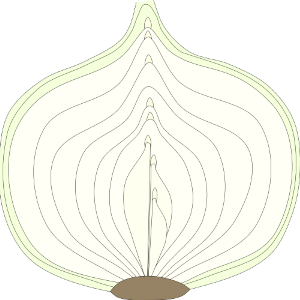 Illustration of onion bulb formation Diagram of the Formative Layers as Seen in an Onion Cross-Section Diagram of an onion with leaf blade and leaf sheath
 - Illustration of how tomato fruits form and side shoots
![トマトの初期段階のイラスト]() Illustration of how tomato fruits form and side shoots Diagram of tomato seedlings before the first flower cluster appears Diagram showing the first flower cluster developing before and after tomato planting
Illustration of how tomato fruits form and side shoots Diagram of tomato seedlings before the first flower cluster appears Diagram showing the first flower cluster developing before and after tomato planting - Illustration of how cucumber fruits form and tendrils
![生長しているキュウリの樹形、「親づる一本仕立て」のイラスト]() Illustration of how cucumber fruits form and tendrils Diagram of a single-stem cucumber vine Diagram of cucumber fruit formation in the “node-type (main stem type)” pattern Diagram of cucumber fruit formation patterns: “Skipped-node type and lateral branch type”
Illustration of how cucumber fruits form and tendrils Diagram of a single-stem cucumber vine Diagram of cucumber fruit formation in the “node-type (main stem type)” pattern Diagram of cucumber fruit formation patterns: “Skipped-node type and lateral branch type”